
Mobile App Development Company: iOS & Android
We build high-performance, user-friendly mobile apps for iOS and Android.
Mobile App Development: scope and approach
We deliver tailored mobile solutions for your business needs. Using React Native and Expo, we build fast, secure and scalable mobile applications. From design to publishing, we support you at every step of the process. Our comprehensive mobile solutions include user experience-focused interface design, push notification integration, offline support and app store optimization (ASO). We also run store publishing, from Apple Developer and Google Play Console account setup to review and release management. The app's privacy policy and KVKK processes are reviewed and approved by the partner law firm we work with in parallel; this is included in the package.
We also take your app to the stores
Technologies we use
Who it is for and what it solves
Your customers now reach for their phone first to place an order, book an appointment or check stock. A mobile app can answer that habit directly, but not every business needs one, and not every idea has to start as an app. So we begin by asking whether something installed on the device is really necessary. If you need notifications, the camera, location or a presence in the app stores, an app makes sense; if you do not, a mobile-friendly web app or a PWA can be a far more economical route.
We build apps with React Native and Expo. One codebase produces both the iOS and the Android version, so a new feature moves forward on both platforms together, you do not have to coordinate two separate teams, and maintenance happens in one place. If a requirement pushes against the limits of that approach, such as a special hardware integration or heavy graphics work, we say so during discovery and weigh the alternatives with you.
This page is written with two kinds of buyers in mind. The first is small and mid-sized businesses that want to offer an app to their own customers or staff: appointments, order tracking, field teams, loyalty or information apps. The second is agencies that need a technical partner to deliver a client's mobile request. When we work with agencies we put the division of roles in writing from the start: who talks to the end client, whose name the store account is opened under, and who raises change requests. That keeps the project free of surprises halfway through.
What we do in Mobile App Development
iOS and Android from one codebase
We build both platforms together with React Native and Expo. Shared logic stays shared, while we adapt to each platform's own habits, such as back navigation, notification permissions and keyboard behavior. When Expo's ready-made modules are not enough, a custom native module can be used; that calls for a development build, and we state the cost impact up front.
Interface and user flow
Before any coding we sketch the screen flows and turn them into a clickable prototype. We account for one-handed use, small screens, font scaling and sufficient contrast from the beginning. If you have a brand kit we follow it; if not, we build a design system as light as the app needs.
API and existing-system integration
An app rarely works alone; it talks to your ERP, CRM, e-commerce platform or your own database. We design for authentication, session renewal, errors and slow connections. If the system you need to reach has no usable API, we propose a small backend layer. When offline use is required, we agree early on which data lives on the device and how conflicts are resolved.
Push notifications and in-app routing
We treat notifications as part of the user experience, not just a technical feature: when permission is requested, whether a notification opens the right screen (deep linking), sending to user groups, and letting people switch notifications off easily. Under the hood we use Apple's and Google's notification services, together with Firebase where it helps.
Store preparation and release
We prepare the app record, descriptions, screenshots and privacy declarations for the App Store and Google Play. Apple's privacy details and Google's data safety form are filled in to match what the app actually collects. For apps that allow account creation, store rules such as an account deletion option are handled during development. We also tune the title, description and visuals for store search visibility (ASO), without promising rankings.
Maintenance after launch
iOS and Android ship new versions every year, and the stores raise their minimum target requirements over time. Optional maintenance covers those compatibility updates, dependency upgrades, crash-report follow-up and small fixes. Fixes that only touch the JavaScript layer can sometimes ship without waiting for store review, while any update that changes native code needs a new store release.
Process
Goal, users and first-release scope
We talk through who will open the app, in what situation and why. We define the smallest useful first release and keep everything else on a separate later list. In the same session we settle the app, PWA or mobile-web question.
Flow and prototype
We sketch the screens and build a clickable prototype. We suggest showing it to a few of your real users; a change made before coding costs far less than the same change made afterwards.
Accounts and technical foundation
We plan for the Apple Developer and Google Play accounts to be opened in your name, and we gather what a release needs early: app identifier, privacy policy and notification keys. On the backend and API side we establish what already exists and what has to be written.
Build with regular internal releases
We build features in short cycles and, at the end of each, share an installable version through channels such as TestFlight and Google Play internal testing. You see the app on your own phone and give feedback early.
Testing and store file
We try edge cases on different screen sizes and OS versions: slow connections, denied permissions, dropped sessions. For the stores we prepare descriptions, screenshots, privacy declarations and the demo account details that the review team will need.
Release and store review
We submit the app for review and respond to any feedback from the store. Review time and outcome are in the stores' hands, so instead of promising a fixed date we recommend leaving a buffer in your launch calendar. Where it helps, we release in stages.
Post-launch follow-up
We watch crash reports and user feedback and prepare the first fix release. After that we decide together whether a regular maintenance plan or work on request suits you better.
What affects the price
Number of screens and flow complexity
A five-screen catalogue app and a multi-step, role-based ordering flow are not the same job. It is less the number of screens than the number of states and exceptions on each one that sets the scope.
Backend and integrations
Connecting to a ready, documented API is very different from writing the backend from scratch. The number of systems to connect, the quality of the other side's API and any offline requirement are among the most decisive lines in a quote.
Design needs
If you already have a brand kit and approved designs, the design load drops. Interface work from scratch, an icon set, animation and prototype testing are quoted as a separate scope.
Device features
Camera, location, biometric sign-in, file upload, maps and notifications each add build and test effort. Features that need a custom native module also affect the scope.
Accounts, roles and payments
User registration, several permission levels and taking payments all raise the security and testing load. If you sell digital goods, the stores' in-app purchase rules and commissions may apply; those are the stores' terms, not an item on our side.
Store accounts and third-party services
Apple and Google developer account fees belong to the account holder, which is you, and are not part of the quote. Usage-based services such as maps, SMS, notification delivery and servers are shown as separate lines.
Maintenance scope
After launch you can choose between regular maintenance and work on request, covering OS compatibility, dependency updates and bug fixes. New feature development is planned separately from maintenance.
An exact price is given once the scope is clear. In a free initial consultation we listen to your needs, then prepare an itemized quote. Write to us for a free consultation
Example projects
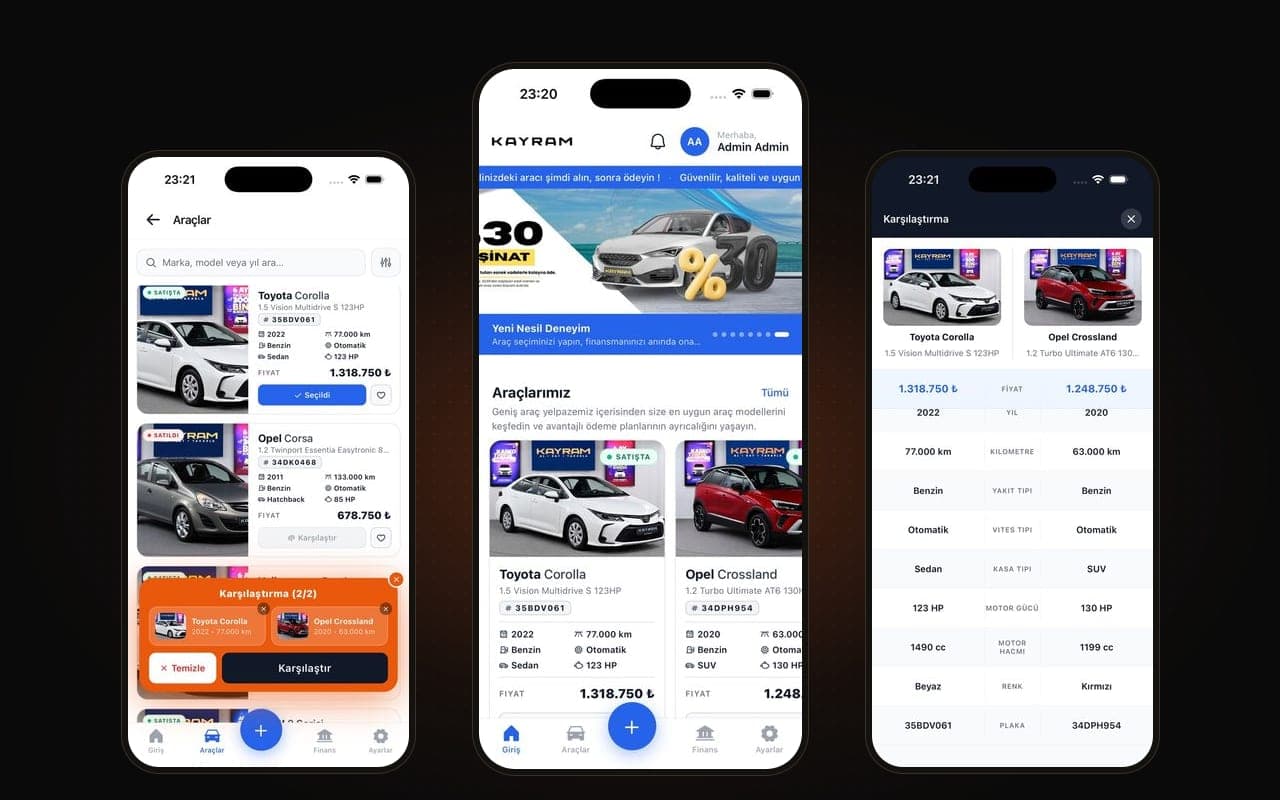
The mobile app in our reference list is Kayram Auto. It is live on the App Store and Google Play for iOS and Android, and it puts the vehicle portfolio on the phone with advanced filtering, vehicle comparison and inspection and damage details. The same brand's web platform at kayramauto.com is also among our references, with a broad vehicle portfolio, brand and model pages, budget-based search and a quick application flow. Together they show how one brand appears on both web and mobile.
Mobile App
Kayram Auto
iOS & Android Mobile App
Mobile app that puts Kayram Auto's vehicle portfolio in your pocket: advanced filtering, car comparison, detailed inspection and damage reports. Live on the App Store and Google Play.
View the app Kayram Auto (opens in a new tab)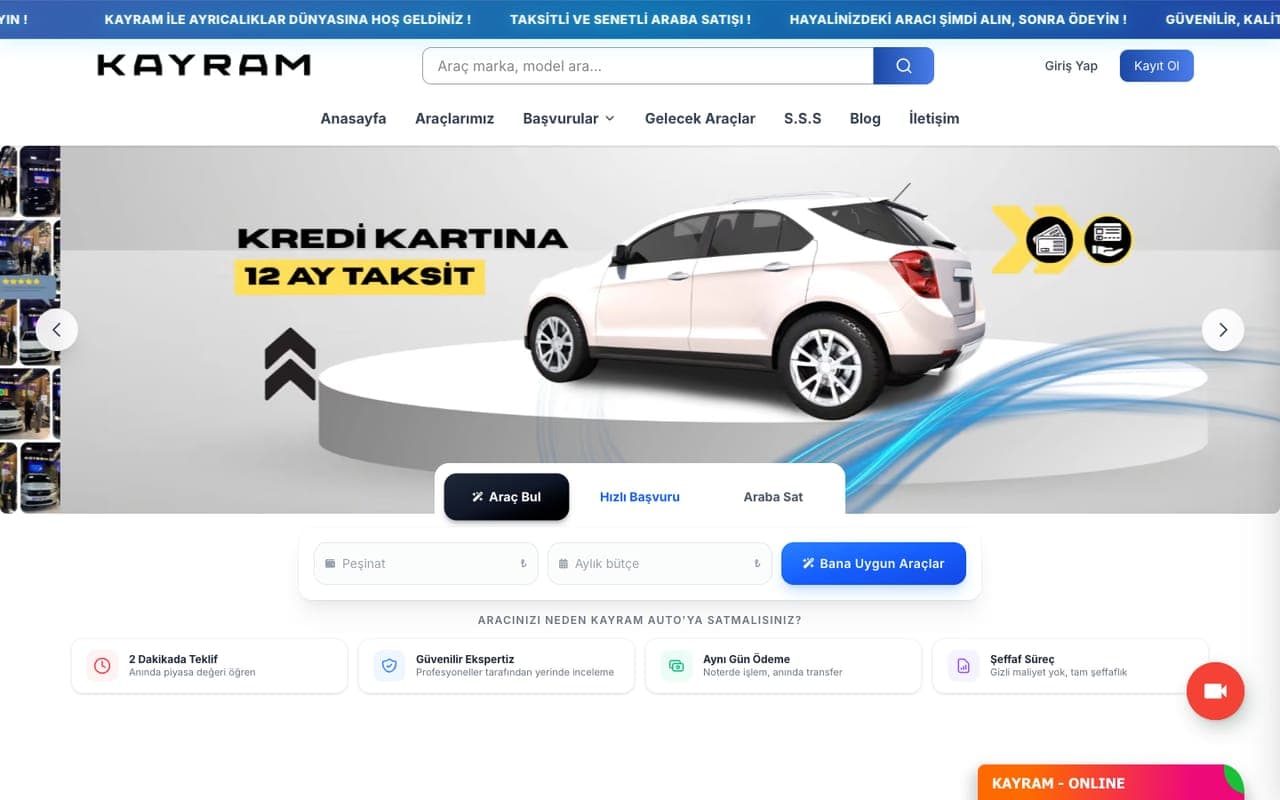
Automotive
Kayram Auto
Car Financing & Sales Platform
Web platform built for Kayram Auto, a dealer selling cars on credit and instalments: a large vehicle portfolio, brand and model pages, budget-based car finder and a quick application flow.
Visit the live site Kayram Auto (opens in a new tab)
Frequently asked questions
Should I build a mobile app, a PWA or just a mobile-friendly website?
An app makes sense if you want users to find you in the store, receive notifications or use device features such as the camera and location. If you mostly show information or collect forms, a mobile-friendly website or a PWA costs less and is faster to update. In discovery we compare your need against these three options, and if you do not need an app we say so plainly.
Do React Native apps perform as well as native apps?
Most business-app needs, such as lists, forms, maps, notifications and payments, are comfortably met with React Native. For heavy 3D graphics, games or very specific hardware integrations, native development may be the better fit. We assess honestly which side your project falls on during discovery.
Who should open the Apple and Google developer accounts?
We recommend opening them in your name, so the app, its reviews and its revenue records stay with your brand. An Apple organization account may require company verification, which is started from your side. We join the account with a developer role and carry out the release steps. Who holds the code repository, configuration and account details is stated in writing in the quote and the contract.
What happens if the store rejects the app?
Rejection reasons are usually crashes, a missing privacy policy, a login screen the reviewers cannot get past, or an inconsistent store listing. We work through these in a pre-release checklist. If a rejection still comes, we read the reason, fix it and resubmit. Because review times are controlled by the stores, we do not promise a firm release date.
Can the app talk to our existing ERP, CRM or e-commerce system?
Yes, if the system offers a way in, such as an API or webhooks. If it does not, putting a small backend layer in between is often possible; we clarify its scope and risk in discovery. The quality of the integration mostly depends on the other system's documentation and the access permissions you can arrange.
What should we watch for with user data and privacy law in the app?
We make sure only necessary data is collected, permissions are requested at the moment they are needed, a privacy notice and policy appear in the app and on the store page, and an account deletion flow is designed. The stores' privacy forms are filled in to match the real data flow. The legal side and KVKK processes are reviewed and approved by the partner law firm we work with in parallel (included in the package); we implement the technical part.
Does the app need updates after launch?
Yes. Operating systems arrive with new versions every year, the stores can raise the minimum version an app must target, and libraries are updated for security and compatibility. An app that is not updated risks being pulled from the store or misbehaving on new devices over time. That is why we discuss maintenance as an optional line in the first quote.
Related services
- Web DevelopmentWe develop fast, secure and scalable web applications with modern technologies.
- Cloud ServicesWe deliver secure and scalable cloud solutions on AWS, Google Cloud and Azure.
- Creative ProductionWe provide professional ad film production, corporate video production and user-focused UI/UX design services.